Ricordea yuma: care and identification
A sourced Ricordea yuma care guide: identification versus Florida, lighting acclimation, flow, attachment, feeding and a not-opening checklist.
Reef editorial · Updated Oct 13, 2026
Ricordea yuma, often called a yuma mushroom coral, is a fleshy corallimorph with a disc covered in rounded tentacles. It does not build the hard skeleton of a stony coral. Its texture and color make it conspicuous, but successful care starts with attachment, gradual acclimation and a stable aquarium—not a collector nickname or a single lighting number.
This species reference brings together taxonomic records and published grower guidance. It is not a report of a yuma specimen kept by Reef.
Species basics
The World Register of Marine Species accepts Ricordea yuma (Carlgren, 1900), in the family Ricordeidae and order Corallimorpharia. The original name was Discosoma yuma; an old name in the literature is not a reason to identify every modern Discosoma listing as a yuma.
Ricordea is the genus; Ricordea yuma and Ricordea florida are different species within it. If a seller labels a coral only Ricordea, ask which species they mean.
Tidal Gardens describes yuma as Indo-Pacific, compared with the Caribbean R. florida. WoRMS also records Indian Ocean specimen localities, including Tanzania and the Seychelles. These geographic distinctions describe species context, not the collection origin of an aquarium frag.
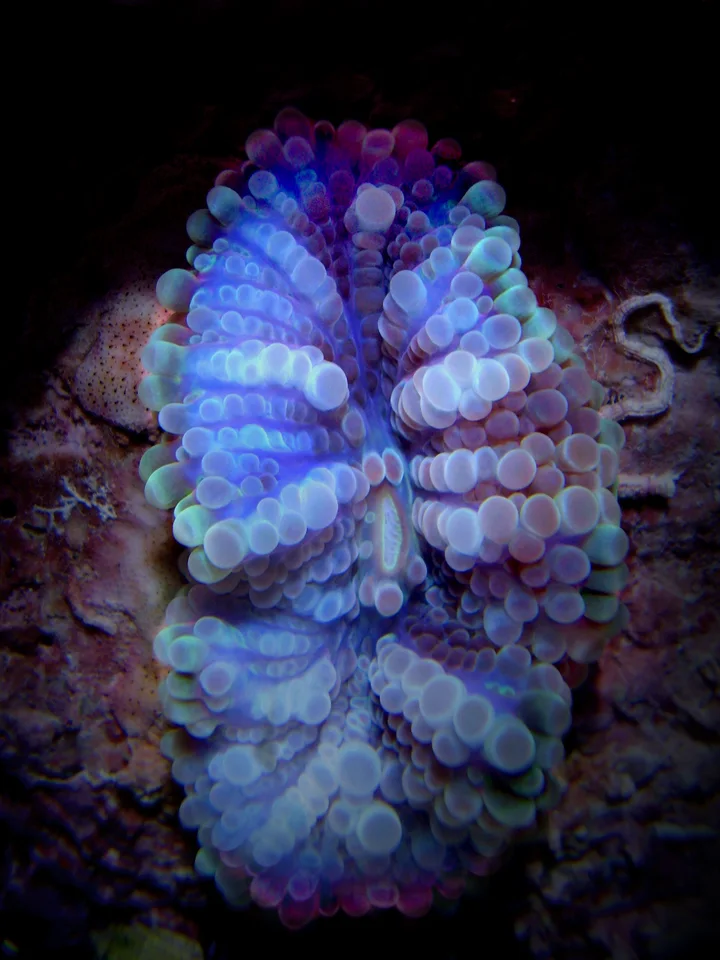

Ricordea yuma vs. Ricordea florida
Look at the arrangement of the tentacles, not color alone. Tidal Gardens gives two useful visual clues:
| Feature | Yuma | Florida |
|---|---|---|
| Around the mouth | Often a dense concentration of tentacles close to the mouth. | The mouth is usually more isolated from the surrounding tentacles. |
| Across the disc | Tends to have alternating rows of larger and smaller tentacles radiating outward. | Tentacle distribution is more irregular, even when colors form rings. |
These are grower identification clues, not a guarantee from one photograph. Expansion, angle and lighting can obscure the pattern. Ask for a clear view of the mouth and whole disc when a seller’s identification is uncertain. Neither feature authenticates a named strain.
Lighting: acclimate rather than copy a chart
Care sources do not supply one universal optimum. Tidal Gardens describes medium-to-high light for Ricordea generally; Frag Box’s yuma guide lists moderate lighting and cautions against both total shade and extreme intensity. A seller’s “low” or “medium” category is not a measured prescription for your aquarium.
Ask about the previous system and start a new arrival conservatively rather than moving it straight into the brightest display position. Increase exposure gradually while watching whether the polyp opens consistently and stays attached. Record its position, lighting program and any measured PAR so later changes have context. Do not interpret brighter fluorescence as proof that the lighting is better for the animal.
Flow, attachment and neighbors
Both Tidal Gardens and Frag Box favor modest flow. Aim for indirect movement that keeps debris from settling without forcefully folding the disc or blowing the animal around. Choose a stable attachment surface, avoid a direct pump jet and leave space from neighboring corals; Frag Box notes that yumas can sting on contact.
If a polyp detaches, review flow and recent handling before repeatedly moving it. Tidal Gardens recommends a low-flow area with rubble for reattachment. Keep a loose animal away from pump intakes. Repeated detachment is a reason to investigate conditions, not proof of one specific deficiency.
Water stability matters
Tidal Gardens reports that R. yuma can be more sensitive to water quality and harder to maintain long-term than R. florida. That is a useful counterweight to broad “easy mushroom” labels. A coral lacking a stony skeleton still needs appropriate, stable marine water conditions.
Check temperature, salinity and the aquarium’s recent maintenance history when its behavior changes. Avoid chasing several numbers at once or making abrupt corrections on the strength of one photograph. Log what changed and when; consistent observations are more useful than guessing from a single contracted polyp.
Feeding and natural division
Ricordea can accept small meaty foods. Tidal Gardens discusses finely sized offerings and notes that a feeding response does not necessarily mean the food was swallowed. Offer a small amount, observe whether it is taken, and avoid leaving excess food on the animal or in the aquarium. Feeding is not a guarantee of faster growth.
Grower guides describe longitudinal fission: an animal develops additional mouths and gradually separates into polyps. There is no fixed timetable that applies to every yuma. A temporary change in disc size is not the same as new tissue or a newly established offspring. This guide favors observing natural division rather than providing a cutting recipe.
Why is my yuma not opening?
Contraction alone does not identify a disease or prove that a particular PAR or nutrient value is wrong. Work through the recent history first:
- Timing: was it just transported, handled, moved or fed? Compare observations at the same point in the lighting cycle.
- Position: is a pump hitting it directly, is debris collecting, or is a neighboring coral making contact?
- Light: did intensity, spectrum, photoperiod or placement change abruptly?
- System: verify temperature and salinity with functioning instruments and review recent maintenance or dosing changes.
- Trend: record attachment, expansion and any visible tissue deterioration with dated photographs. Persistent decline warrants experienced help rather than repeated speculative adjustments.
A useful observation log needs only the date, position, light setting, flow, attachment, expansion, feeding response and changes made. Alter one controllable condition at a time where practical so the response is interpretable.
Where do Doughboy and Bean Bag fit?
Doughboy and Bean Bag are collector trade names, not separate species or a substitute for provenance. For the original appearance description, comparison with OG Bounce and a buyer’s documentation checklist, read Doughboy / Bean Bag Yuma mushroom.
Sources and further reading
- WoRMS: Ricordea yuma, AphiaID 290996 — accepted taxonomy, original name and specimen records.
- Tidal Gardens: Ricordea mushroom care — identification, distribution and grower husbandry guidance.
- Frag Box: Yuma coral — species-level placement, flow and division guidance.
Sources reviewed October 13, 2026. Husbandry guidance above is an editorial synthesis of grower accounts, not a controlled yuma care trial.