Doughboy / Bean Bag Yuma mushroom
Understand Doughboy and Bean Bag Yuma names, adult markings, lineage questions, price factors and what to check before buying a mushroom coral.
Reef editorial · Updated Oct 13, 2026
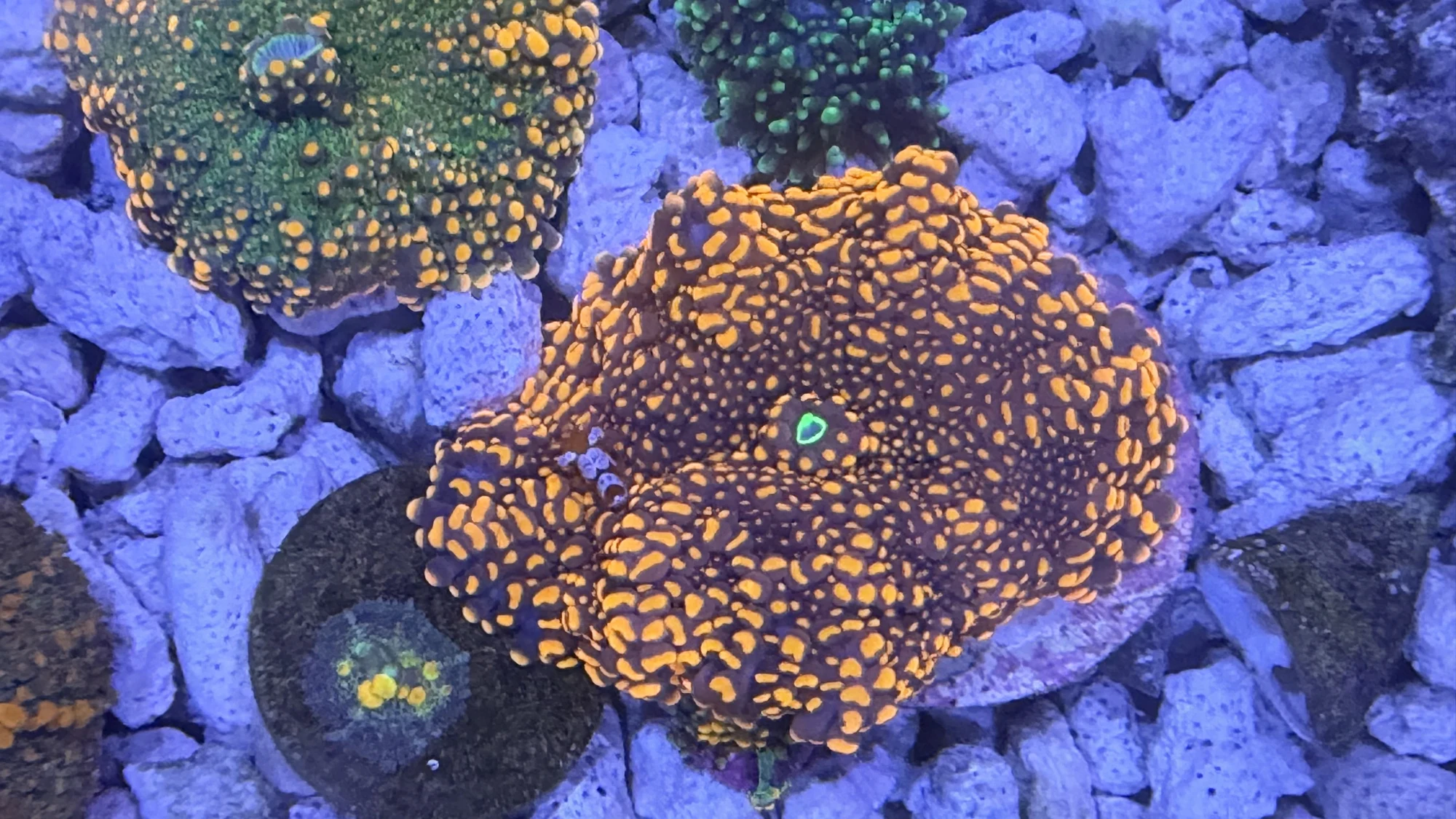
A Doughboy mushroom coral is a collector-market name applied to a bubble-textured mushroom commonly described as Ricordea yuma. You may also see “Bean Bag Yuma,” “Beanbag,” or an RRC prefix. These are trade labels, not formal species names or automatic proof that two sellers’ animals share the same parent.
The useful distinction is simple: identify the kind of coral, then assess the evidence for the named strain. This guide explains the original Bean Bag description, how the names are used, and what to ask before paying a collector premium.
What makes a Bean Bag Yuma distinctive?
In Jake Adams’ 2019 Reef Builders account, Bean Bag was an R. yuma morph with irregular red-orange stripes or squiggles across its swollen vesicles—the rounded projections on the disc. The report associated its introduction with Reef Raft Canada and contemporaneous promotion by Georgina Clark. That history does not authenticate the lineage of a frag offered today.
The striking feature was not simply large bubbles. It was the contrasting pattern on individual vesicles, especially on mature polyps. Adams also described young offspring that looked much like ordinary orange yumas, without the adult squiggles. An unmarked juvenile therefore needs a documented parent history; being orange does not predict that it will develop this appearance.
For actual morph photographs, open the original Bean Bag photo report or New Dawn Aquaculture’s Doughboy source page. Compare the adult and juvenile context, not just fluorescence. Blue aquarium light, exposure and editing can change how colors look.
Doughboy, Bean Bag, Doughgirl and OG Bounce
Retailers combine names such as “Doughboys Beanbag Yuma”, while others use “Doughboy Ricordea Yuma.” This documents overlapping trade usage, not a universal pedigree. Ask what the seller means by the label.
| Label | How to read it |
|---|---|
| Bean Bag / Doughboy yuma | A named Ricordea yuma-type collector look. Neither spelling proves descent from the originally reported animal. |
| RRC Doughboy / Bean Bag | A reference to Reef Raft Canada. Ask for the acquisition and propagation records supporting that connection. |
| Doughgirl | Do not infer a parent, offspring or sex relationship from this trade name. Ask for the seller’s identification and provenance separately. |
| WWC OG Bounce | A separate collector label marketed as Rhodactis, for example by Corals of Eden. It is not another name for Bean Bag yuma. |
| Bounce mushroom | An appearance-based hobby term, not a species identification or lineage certificate. |
Comparing another collector mushroom? The OG Bounce buying guide explains a different bounce trade name; Jawbreaker covers seller-labeled Discosoma; Sunkist Bounce focuses on orange-bubble listings; and Godzilla Yuma / Bounce looks at inflated vesicles and the seller details worth checking. None of these names is a synonym for Doughboy or a substitute for documenting its parent.
Species identification and strain authentication are different questions. Tidal Gardens’ comparison uses tentacles around the mouth and radial rows of larger and smaller tentacles as useful yuma clues. Those features do not identify a particular named strain. If a listing’s title and taxonomy field disagree, ask for clarification rather than treating either as definitive.
Five checks before buying a frag
- Identify the pictured animal. Is it the exact polyp offered, the mother, or a representative stock photograph? “WYSIWYG” should mean the actual animal, not a promise of its future appearance.
- Request comparable photographs. Ask for a current image with a size reference, the normal display-light view and a neutral-light view. Ask which markings are present now and which appear only on the parent.
- Trace the parent. Request dated mother-and-offspring photographs, the source of the parent and available acquisition or propagation records. These strengthen an account of provenance but are not genetic certification.
- Check establishment. Ask how long the animal has been attached and in the seller’s system, whether it was recently cut, and whether it has been persistently detaching. Ask about its current light and flow before planning acclimation.
- Read the transaction terms. Compare the actual animal, currency, pickup or shipping arrangements, temperature precautions and arrival guarantee. A beautiful photograph is not a substitute for clear terms.
Without credible parent history, a seller’s “Bean Bag–style yuma” may still be an appealing coral. Valuing its appearance and condition is different from paying for verified lineage.
Why Doughboy asking prices vary
A small juvenile, an established adult and a recently cut frag are not equivalent purchases. Size, visible pattern, attachment, documented provenance and the seller’s guarantee all affect what is being offered. Compare like with like before comparing headline prices.
Retail asks are not completed-sale evidence. Sale tags, sold-out pages and multi-coral bundles do not establish a reliable market value for one Doughboy. This is a collector guide, not a Reef inventory listing or price quote.
Care starts with the species, not the nickname
There is no substantiated universal “Doughboy PAR” or guaranteed multiplication schedule in the sources below. Even sellers’ categories differ: Candy Corals describes low light and low flow, while New Dawn describes medium light and medium flow. Treat those as seller guidance, not a controlled comparison.
Start with the animal’s previous conditions, acclimate deliberately, provide modest indirect movement and observe attachment and expansion. For species identification, placement, feeding and troubleshooting, read our Ricordea yuma care and identification guide.
Bottom line: buy a documented, established specimen at a price you accept—not a promise that an untracked juvenile will develop identical markings.
Sources and further reading
- Reef Builders: Bean Bag Yuma Ricordea — contemporary history and photographed adult/juvenile description, October 16, 2019.
- Tidal Gardens: Ricordea care — grower identification and husbandry guidance.
- New Dawn Aquaculture, Candy Corals and Koral King — examples of seller naming and care categories, not independent lineage verification.
- Corals of Eden: WWC OG Bounce — an example of the separate Rhodactis trade label.
Sources reviewed October 13, 2026. This is a sourced editorial guide, not an account of a Doughboy specimen kept by Reef.